 Dali Marketers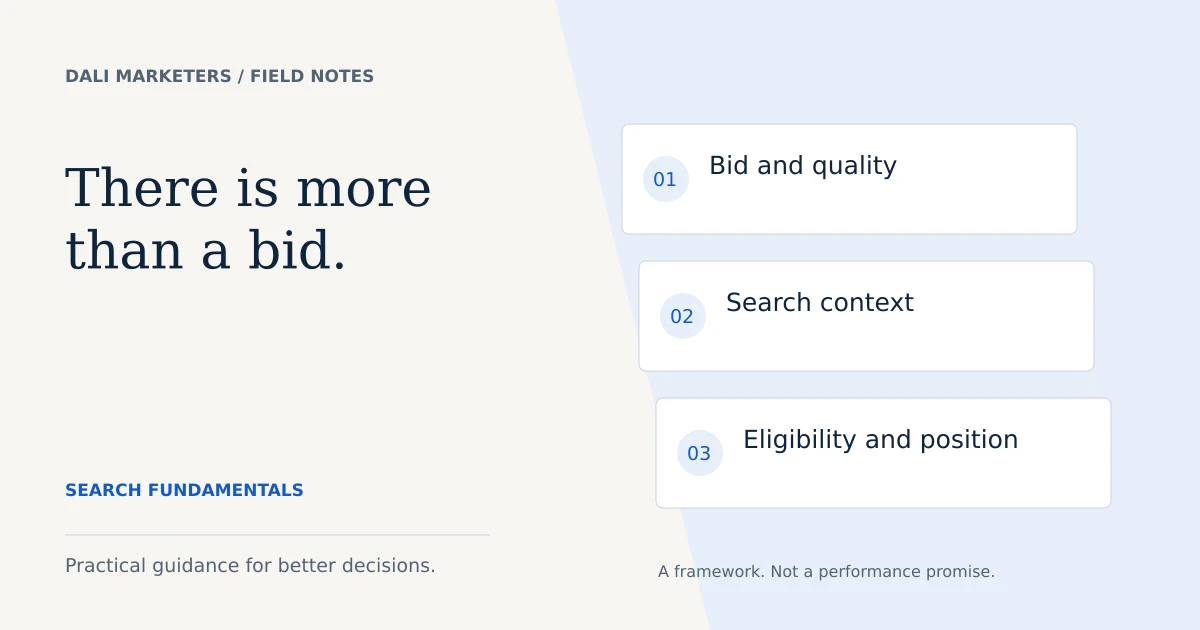
The quick answer
Ad Rank determines eligibility and placement using several factors. Increasing a bid is only one possible response to limited visibility.
A search creates an opportunity, not a guaranteed impression
When someone searches, eligible advertisers can compete for available ad placements. Having an active campaign does not guarantee that your ad appears for every relevant search.
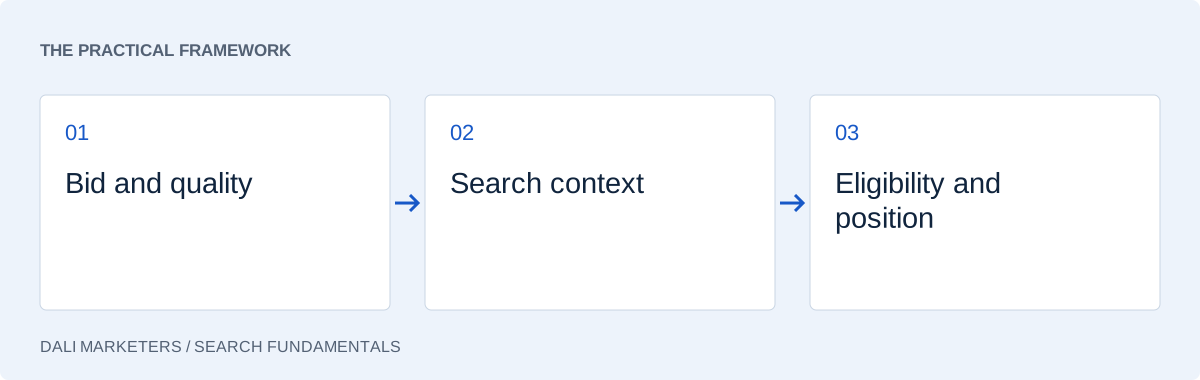
Google uses Ad Rank to assess whether an ad can show and how it is positioned relative to other eligible ads. Bids matter, but so do ad quality, thresholds, competition, search context and the expected contribution of ad assets and formats.
That is why two advertisers with different offers and destinations cannot assume that the larger bid always produces the better placement.
Keep reported Quality Score separate from auction-time quality
The 1–10 Quality Score visible in Search keyword reports is a diagnostic. Google states that the displayed score is not an auction input. Auction-time quality is assessed in the context of the particular search.
Avoid reducing the system to “bid multiplied by Quality Score”. That shortcut obscures the other factors and can lead to poor decisions. Use the Quality Score guide to understand how the diagnostic can still help you inspect ads and pages.
For business decisions, the important question is whether the relevant audience can find a useful offer at a sustainable acquisition cost.
Why a bigger bid may not solve the problem
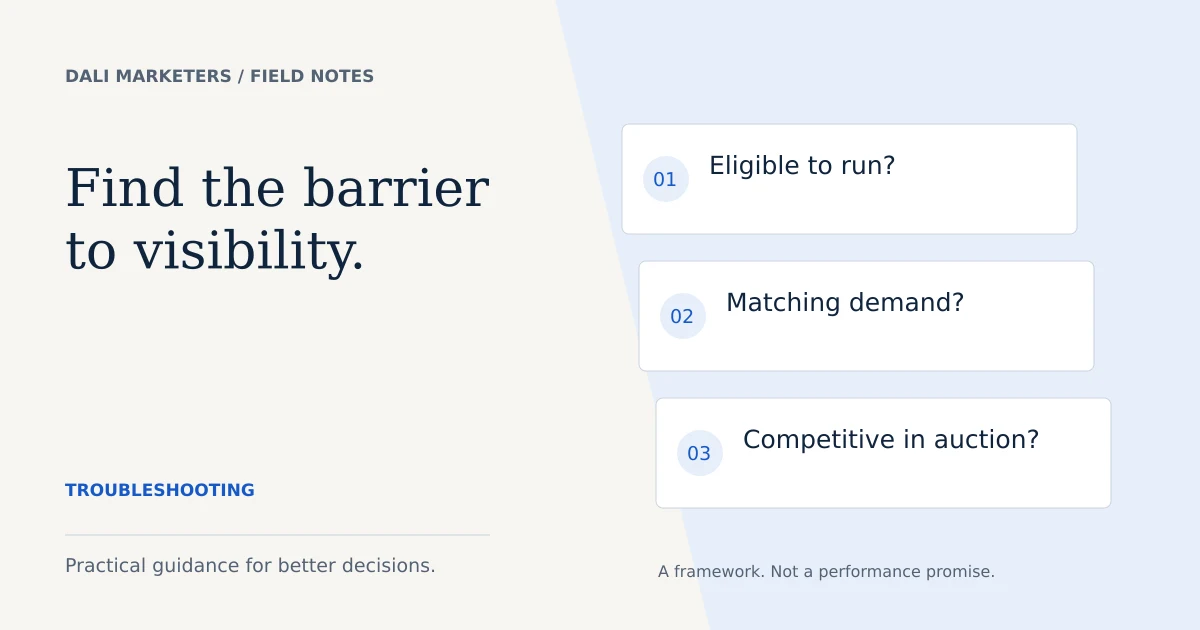
If your destination is broken or your ad is ineligible, spending more is not the first fix. If the campaign targets a very small area with little relevant demand, a higher bid does not create additional people searching for the service.
Check eligibility, targeting and the customer journey before adjusting bids. Where available, Search impression-share diagnostics can help distinguish budget limitations from rank limitations. Interpret them alongside the account’s actual status and volume.
Our ads-not-showing guide gives you a practical order for that investigation.
What affects the click price you actually pay
Your maximum bid or bidding strategy is not a universal fixed price for every click. Auction conditions vary. Avoid using a simple competitor-bid formula as an exact forecast of your actual cost per click.
Instead, inspect your own costs across relevant campaigns, services and periods. Separate expensive traffic that produces useful business from cheaper traffic that does not. The lowest click price is not necessarily the best purchase.
For a service business, a more useful question may be cost per qualified enquiry or customer. Read our cost-per-lead guide for an example of that calculation.
Focus on the parts you can improve
| Area | Useful action |
|---|---|
| Relevance | Align the search need, ad and destination |
| Measurement | Verify the outcomes informing decisions |
| Offer | Make scope and next steps clear |
| Coverage | Check targeting, exclusions and assets |
| Budget | Allocate deliberately using business evidence |
You cannot control every competitor or search context. You can control whether the account’s offer is coherent, whether its conversion data is useful and whether its settings match the business.
Use a business example to frame the decision
Imagine two fictional contractors. One sends all paid visitors to a broad homepage with no clear quotation process. The other sends repair searches to a page explaining the repair service, area covered and next step.
The second journey is easier for a relevant visitor to understand. That does not guarantee a particular position or click price, but it gives the advertiser a concrete area to improve. Raising bids on the first journey without checking it may simply bring more people to the same weak experience.
Evaluate page and campaign changes using accurate enquiries and sales feedback. A prominent ad that generates unsuitable leads is not automatically successful.
Build a review habit rather than chasing position
Write down what the business needs from advertising, inspect whether the measurement reflects that need and review the constraints on serving relevant demand. Then choose a focused adjustment.
For an existing account, our Google Ads audit can identify the areas worth investigating. If you need recurring budget reviews, testing and reporting, explore ongoing Google Ads management.
Understanding the auction helps you ask better questions. It does not remove the need to test whether the advertising is commercially useful for your business.
Sources & further reading
Platform details checked against these Google resources on 23 September 2026. Examples and diagnostic frameworks are explanatory; account results will vary.